
POKERSTARS x SISAL
TL;DR / Summary.
The Sisal project marked the inaugural launch of the PokerStars Network initiative, bringing the PokerStars poker product onto Sisal's platform for the Italian betting market, serving a user base of 35 million. It was the first of its kind for PokerStars, and the work produced here became the foundation upon which the PokerStars' "Fusion" Design System was later built.
I was appointed by the Brand Director to lead a cross-functional team of Senior and Principal Designers across two distinct but connected phases. The first was a two-day cross-team colour workshop spanning eight product teams, incorporating user testing to validate colour direction and producing a unified set of colour palettes, principles, and documentation that would underpin everything that followed.
Building on those foundations, I led the creation of a comprehensive Design Style Guide from scratch, defining typography scales, spacing, sizing, and border radii, and using the workshop's outputs to build and standardise 40 core and product-specific UI components into a single, implementation-ready reference. The project was delivered two weeks ahead of schedule.
The completed Style Guide was handed over to Sisal's design team, who used it as their primary reference to build the PokerStars theme within their own design system. I supported this process through structured design reviews, prioritised feedback workflows, and a visit to Sisal's Milan office to strengthen collaboration and resolve implementation challenges. PokerStars.it launched successfully, with the project receiving very positive feedback for its collaboration, flexibility, and quality of delivery.
The Brief.
As part of the inaugural implementation of the PokerStars Network initiative, enabling partner companies to host the PokerStars poker product on their own platforms, one of their partners, Sisal, a major Italian betting brand, was set to host the PokerStars poker product on their platform for the Italian betting market.
The product would appear in two environments:
-
On Sisal.it, branded under Sisal
-
On PokerStars.it, a Sisal-hosted domain branded as PokerStars
To ensure successful brand implementation across both, I was appointed by the Brand Director to lead a cross-functional team of Senior and Principal Designers across two connected phases; a cross-team colour workshop to establish the foundational design language, followed by the creation of a comprehensive Design Style Guide. Our objective was to equip Sisal with everything required for accurate, consistent, and scalable implementation of the PokerStars product, serving a platform with a user base of 35 million.

Sisal.it web framework

PokerStars.it theme application
The Colour Workshop
Before work began on the Design Style Guide, the Design Director initiated a workshop to explore whether a new, centralised colour palette could be defined to underpin the components within the guide. Representatives were invited from across PokerStars product teams, and I volunteered to represent Payments alongside designers from Brand, Poker, Casino, Sports, Marketing, Social Gaming, and Mobile. Following initial discussions, I was appointed to lead the two-day workshop; defining the objectives, structuring the agenda, and building the workshop template in Figma in close collaboration with the Design Director.
The session began with a refresher on colour theory, covering harmony principles, the 60:30:10 rule, and practical tools, before moving into product-specific analysis. Each team presented examples of best-in-class colour usage and shared rationale, surfacing inconsistencies across existing palettes and reinforcing the need for a centralised approach. We evaluated fills, gradients, brand alignment, unified versus product-specific colour profiles, and Light and Dark Mode support. A dot-voting exercise formalised a set of core colour principles across the teams, prioritising accessibility, consistency, entertainment value, and meaningful application.

Workshop: decision voting and defining colour principles

Workshop: colour evaluation across the PokerStars ecosystem
Building on these principles, we developed the first iteration of unified light and dark palettes, defining tonal qualities for primary, secondary, and neutral colours alongside extended tints and shades, and identifying candidates for a new Primary Button colour. Designers applied the proposed palettes to high-traffic product screens to evaluate visual hierarchy, brand alignment, and button prominence against the 60:30:10 rule, producing a refined shortlist of Primary Button colour options.
User testing followed. I partnered with the Head of User Testing to provide designs and prototypes for a user research study, testing the current Primary Button colour as a control against three shortlisted colour palettes across Light and Dark Modes. In parallel, a company-wide survey mirrored the user questions to assess internal brand perception. Results identified a clear winner and validated the tonal direction of the broader palette across products.
With the Marketing designer, I created the colour documentation; establishing principles, extended colour palettes, gradient and opacity guidance, and 60:30:10 application rules, alongside system status colours, urgency scales, accessibility standards, Do's and Don'ts, and shared taxonomy to standardise naming conventions. This became the foundational colour framework for the Style Guide and, ultimately, the Fusion Design System.

Workshop: extended colour palettes and shortlisting Primary Button colour candidates

Workshop: designing the user test

Workshop: user testing product pages in light and dark modes
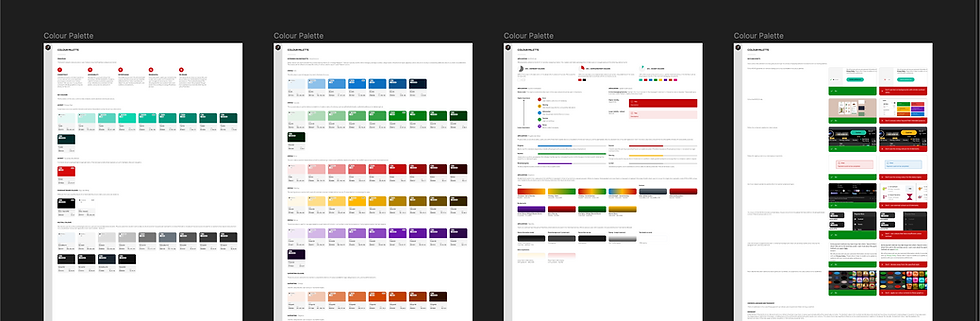
Workshop: colour documentation
The Design Style Guide.
Impressed with how I led the colour workshop, supported user testing, and formalised the colour documentation, the Brand Director appointed me to lead the team responsible for producing the Design Style Guide. The core team included Senior and Principal Designers from Poker, Sports, and Marketing, with additional support from Casino, Social Gaming, Mobile, and Brand when required. With only two months to deliver a comprehensive, implementation-ready Style Guide, I defined a focused delivery strategy from the outset; meeting daily to align, prioritise, and decide which core styles, attributes, and components needed to be standardised first.
Building on the newly established colour system, we consolidated disparate typography styles into a single type scale, defining font sizes, weights, and line heights, and followed the same audit-and-align approach for spacing scales, border radii, surface and border colours, grid systems, and iconography. These foundations supported the rebuild and standardisation of core UI components including Buttons, Inputs, Toggles, and Filters, aligning on design attributes, interaction states, and behaviours across Light and Dark Modes. To support designers using the components, we documented clear guidance around anatomy, hierarchy, orientation, spacing, colour application, and Do's and Don'ts.

Style Guide: Button component

Style Guide: Checkbox component
Once the core components were complete, I delegated additional shared components across the team, including Accordions, Cards, Lists, Messaging, Progress Indicators, Selectors, Tags, Tiles, and more complex components such as headers and navigation. Product-specific components were assigned to the relevant product designers to ensure accuracy and usability. Throughout, I maintained regular communication to track progress and keep stakeholders informed. All components underwent structured UI reviews to verify consistency, accessibility compliance, correct interaction states, and adherence to PokerStars brand principles. Working with the UX Content Writer, we also incorporated PokerStars' Tone of Voice guidelines, covering language principles, tone variation, and writing best practices.
In total, we designed and documented 40 UI components. The completed Style Guide was shared with the Design Director and department heads for review, and through strong collaboration across the team, we delivered the project two weeks ahead of schedule with only minor refinements needed.

Style Guide: Text Field component
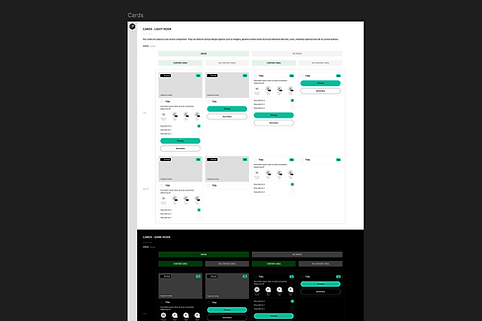
Style Guide: Cards component
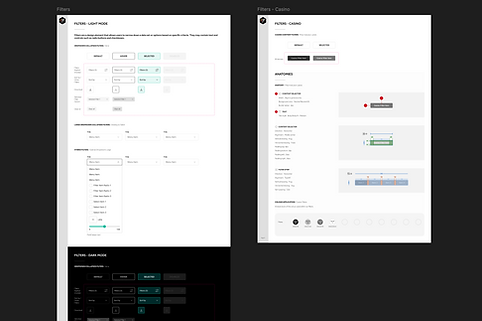
Style Guide: Filter component

Style Guide: Tone of Voice
Enabling Sisal's Implementation.
With the Design Style Guide finalised, I led the handover to Sisal's design team; walking them through the Style Guide in detail, providing an opportunity to ask questions, and aligning on next steps for implementation. To strengthen the working relationship and ensure smooth collaboration throughout the implementation phase, I visited Sisal's design team at their Milan office, working directly with their designers to align on outputs, resolve challenges, and build a stronger cross-company connection.
Using the Style Guide as their primary reference, Sisal's designers built the PokerStars theme within their own design system, applying key branding attributes as design tokens to construct themed components for both broad and granular application. Where framework differences required additional design elements such as elevation and shadows, we collaborated to define appropriate guidance aligned with PokerStars standards, ensuring design parity across default and various interaction states.
Throughout the implementation process, we maintained regular communication and collaboration with Sisal's design team through scheduled review meetings, aligning on theme application, interaction states, and design decisions as their work progressed. Working alongside the Marketing Designer, I reviewed designs in context and provided structured feedback to ensure consistency, alignment, and brand integrity were maintained throughout.

Sisal Design System: Building the Poker theme

Sisal Design System: Applying the Poker theme to the Buttons

Sisal Design System: Applying the Poker theme to the Checkboxes

Sisal Design System: Applying the Poker theme to the Text Fields
The 9-Grid.
Prior to full implementation, PokerStars' Managing Director commissioned a 9-Grid comparison document to conceptually demonstrate how the Poker product could appear across Sisal.it, PokerStars.it, and PokerStars.com on web, mobile, and desktop platforms, utilising the PokerStars theme.
Working alongside the Marketing Designer and with support from the Senior Sports Product Designer, I took ownership of producing the 9-Grid; collaborating with product owners across multiple teams to gather content and information, structuring the document in a clear and concise way, and creating visuals across key areas including the homepage, table views, product pages, promotions and rewards, account settings, and registration flows. Where planned features had not yet been executed, I produced conceptual designs to provide a holistic view of how certain aspects of the product could look in the future, ensuring the document presented a complete and compelling picture.
The completed 9-Grid was presented to the Managing Director for review and amended accordingly, before being shared with leadership teams at both PokerStars and Sisal to align expectations, highlight discrepancies, and secure final sign-off ahead of implementation.

9-Grid: Homepage - Member state

9-Grid: Product Page - Spin & Go

9-Grid: Poker Tables

9-Grid: Account Settings
Creation of PokerStars.it.
With the 9-Grid approved and implementation underway, Sisal proceeded with building PokerStars.it using their existing web framework as the foundation. The PokerStars theme was applied across pages, components, and icons as a reskin. Branding imagery was incorporated where necessary, and tone of voice translated into Italian was embedded throughout the site.
The theme spanned a comprehensive range of pages and user journeys across the Poker product, including the homepage, poker product page, in-game poker experience, promotions and rewards, account management, loyalty scheme, registration journey, and nickname assignment journey. Each touch-point was carefully considered to ensure the PokerStars brand was accurately and consistently represented within Sisal's framework, whilst maintaining the usability and familiarity of the established user experience.
Meanwhile, the poker product integrated into Sisal.it retained Sisal's branding, though Sisal's designers continued to reference the Style Guide for poker-specific components to maintain consistency across both environments.

Poker Tables: PokerStars and Sisal branding applied

Poker Lobby: Cash Games - No Limit Hold'em
From Feedback to Launch.
As deadlines approached, the Style Guide team and I maintained close collaboration with Sisal's design and development teams, ensuring progress was visible and questions could be quickly answered. With Sisal's designs and user journeys complete, they provided five Figma files spanning multiple pages for review. Working alongside the Marketing Designer, I reviewed the designs in context and consolidated feedback into a comprehensive spreadsheet, introducing a prioritised amendment system ranking feedback by:
-
Brand alignment (imagery, licensing)
-
Accessibility issues
-
Lower-impact visual refinements
Where the Style Guide lacked contextual reference, such as the overuse of brand red on the PokerStars.it homepage, or where framework constraints introduced design limitations, we remained flexible and adapted quickly. We proactively designed alternative solutions and presented them to design stakeholders across both PokerStars and Sisal for alignment.
With amendments implemented and reviews completed across both design and development teams, PokerStars.it launched successfully. The migration of player accounts from the PokerStars platform to Sisal achieved a 99.99% success rate, a testament to the accuracy and consistency of the design and implementation work throughout the project. The project received very positive feedback from senior stakeholders for the collaboration, flexibility, and quality of delivery demonstrated throughout. As an MVP release, further refinements continue to be introduced post-launch to strengthen the experience and brand alignment.

PokerStars.it - poker theme applied to the Homepage design

PokerStars.it - poker theme applied to the Spin & Go page
Long-Term Impact.
The Design Style Guide proved to be far more than a project deliverable; it became the foundational reference upon which the Fusion Design System was built. The design attributes established during the Sisal project, including the typography scale, interaction states, core component structures, and documentation, provided the launch pad for Fusion's creation and continue to underpin the system today.
The close collaboration with Sisal also had a direct and lasting impact on Fusion's development. The working relationship built throughout the project gave us ready access to Sisal's design files and style guides, enabling us to build the Sisal theme within Fusion with relative ease. As the first partner theme added to the Design System, it provided an invaluable platform to validate our theming approach, demonstrate what Fusion could achieve, and establish a scalable model for the partner themes that followed.